Drafty Windows? How to Find Where the Cold Air Is Really Coming From
Most drafts are not coming through the glass. They are coming around the sash, the frame or the wall. Four simple tests you can do tonight, and what each result means.
A drafty window is the most common reason people start thinking about replacement. But "drafty" can mean several different problems, and some of them are cheap to fix.
Before anyone quotes you for new windows, it is worth finding out where the cold air is actually getting in.
Where drafts come from
There are four usual suspects:
- Between the sash and the frame — worn or missing weatherstripping, or a sash that no longer closes tight.
- Around the frame, between the window and the wall — poor or deteriorated insulation and air sealing from the original install.
- Through the glass itself — not air, but cold radiating off a poorly insulated pane. It feels like a draft.
- Convection — warm air cools against cold glass, sinks, and rolls across the floor. Also feels like a draft, even with zero air leakage.
Four tests you can do tonight
The back-of-hand test. On a cold, windy evening, move the back of your hand slowly around the edges of the sash and then around the trim. Moving air is noticeable; a cold but still surface is radiation.
The incense or candle test. Hold a lit incense stick near the same edges. If the smoke bends or flutters, you have found an air leak. Keep flames away from curtains.
The paper test. Close the window on a strip of paper. If it slides out easily, the sash is not sealing against the frame.
The lock test. Does the window lock without forcing it? Can you see daylight at the edges when it is shut? A sash that no longer pulls tight is a leak regardless of how good the glass is.
What each result means
| What you found | Likely fix | Replacement needed? |
|---|---|---|
| Leak between sash and frame, window otherwise good | New weatherstripping or hardware adjustment | Often no |
| Leak around the trim / frame edge | Remove trim, re-insulate and air-seal | Sometimes no |
| No air movement, but the glass is freezing | Glass is too cold for your climate | Usually yes |
| Sash warped, will not lock, rot at the sill | Window at end of life | Yes |
| Several of the above at once | Window and install both tired | Yes |
When replacement is the right answer
Replacement makes sense when the problem is the window itself — failing glass, a warped or rotting frame, hardware that cannot be repaired — or when the original install was poor enough that fixing the edges means pulling the window anyway.
When we replace a window, the part people never see matters most: insulating and air-sealing the gap between the new frame and the wall. That is where most drafts live, and it is why the quality of the install counts as much as the product.
Comfort you feel the first night
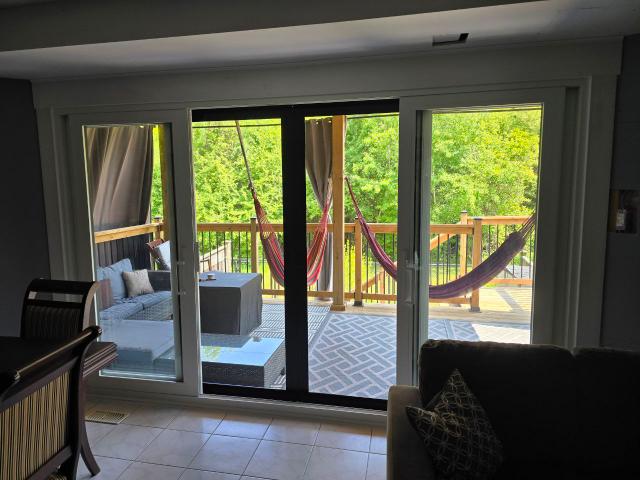
The biggest difference customers describe is not the heating bill. It is being able to sit next to the window in January without a blanket. Rooms stay warm to the edges, and the floor near the patio door stops feeling like a cold spot.
If replacement is the right call, a typical $15,000 project is roughly $319 a month on Financeit's 9.99% / 60-month promotional plan (on approved credit, before any lender fees). See how the monthly number works.
We will tell you at the assessment whether you need new windows or just better seals. Call +1 (778) 361-2515 — live agent, Mon–Fri, 9am–5pm Calgary time.
Related articles
Why Your Windows "Sweat" in Winter — and Why It Is Usually Not the Window
September 28, 2026
Condensation on the Outside of Your Windows? That Is Good News
September 28, 2026
Where Does the Water on Your Windows Come From? Everyday Moisture in Your Home
September 28, 2026
Wet Bedroom Windows Every Morning? Here Is Why
September 28, 2026